 Not everyone's happy about the Americanization of Stieg Larsson's Millenium trilogy (FIC LARSSON). When merchandising agents and unlicensed publicity began capitalizing on the new David Fincher film, a project with its predominately Anglo/American cast talking in Swedish-accented English, it's taking things too far for Eva Gabrielsson, Larsson's former mistress, who this week claimed that Larsson would never have endorsed such a spectacle. She says the deceased author would've used the spotlight to promote his rigid stance against mysogyny, discrimination and violence against women. Even though she doesn't actually own the rights to any of the books (the author's immediate family does, though that's another matter), Gabrielsson said she and Larsson "would have never sold any rights for merchandizing," adding that, "It has nothing to do with the books." Some people may not have gotten the message. Rooney Mara, the American actress playing Lisbeth Salander, said that her character's neither a feminist nor an advocate of any such group or movement, a gesture to which a disbelieving Gabrielsson replied "Does she know what film she has been in? Has she read the books? Has she not had any coaching?" Gabrielsson may have a point here; the literal translation of Larsson's first title is actually "Men Who Hate Women". Oh well. Maybe Mara only read the American translation. To hear more of what Eva Gabrielsson thinks, be sure to check out her own, recently published memoir, "There Are Things I Want You To Know" About Stieg Larsson and Me (839.738 GABRIELS).
Showing posts with label movies. Show all posts
Showing posts with label movies. Show all posts
Thursday, December 22, 2011
More Jawing Over Larsson's 'Millenium' Trilogy
Not everyone's happy about the Americanization of Stieg Larsson's Millenium trilogy (FIC LARSSON). When merchandising agents and unlicensed publicity began capitalizing on the new David Fincher film, a project with its predominately Anglo/American cast talking in Swedish-accented English, it's taking things too far for Eva Gabrielsson, Larsson's former mistress, who this week claimed that Larsson would never have endorsed such a spectacle. She says the deceased author would've used the spotlight to promote his rigid stance against mysogyny, discrimination and violence against women. Even though she doesn't actually own the rights to any of the books (the author's immediate family does, though that's another matter), Gabrielsson said she and Larsson "would have never sold any rights for merchandizing," adding that, "It has nothing to do with the books." Some people may not have gotten the message. Rooney Mara, the American actress playing Lisbeth Salander, said that her character's neither a feminist nor an advocate of any such group or movement, a gesture to which a disbelieving Gabrielsson replied "Does she know what film she has been in? Has she read the books? Has she not had any coaching?" Gabrielsson may have a point here; the literal translation of Larsson's first title is actually "Men Who Hate Women". Oh well. Maybe Mara only read the American translation. To hear more of what Eva Gabrielsson thinks, be sure to check out her own, recently published memoir, "There Are Things I Want You To Know" About Stieg Larsson and Me (839.738 GABRIELS).

Tuesday, September 20, 2011
The Town / Chuck Hogan
 When it comes to movies based on books, I usually try to read the book beforehand. During that interim period between reading it and watching the movie, it's a nice feeling to have in my head the purest form of the story, just the words and my imagination. I have all the details straight from the mouth of the author. Movies are a different format altogether, I understand that, but in translating a book to the big screen, most of those details are left out. So I try to get them in before the movie version invades my impression of the story.
In the case of the 2010 film The Town, however, I ended up seeing the movie first. While this isn't a review of the film, which Ben Affleck directed and starred in, I do have to say that it was excellent. You expect it'll be just a standard action flick about a bunch of bank robbers but it turns out to be much more engaging and interesting than that. I liked it so much that when I saw in the credits that it was based on the 2004 book Prince of Thieves by Chuck Hogan, my interest was piqued. I don't read a lot of crime fiction, so I thought I'd give it a try.
 I'm glad I did. While the movie is overall quite faithful to the book (except at least one major divergence), it lets you get inside the heads to a much greater degree of Doug MacRay, the head of the bank-robbing crew, and Adam Frawley, the FBI agent determined to bring him down. (For a commentary on the movie's adaption of the book, visit "Adapt This: Ben Affleck’s ‘The Town’ vs. Chuck Hogan’s ‘Prince of Thieves'".)
By the way, the library has both the book (FIC HOGAN) and the movie (DVD T). Both are called The Town — don't look for the book under the title Prince of Thieves like I did!
Doug MacRay is a career criminal in his 30s who's finally reached the end of his heisting tether. He's tired of the life and tired of The Town — Charlestown, the roughshod neighborhood and culture that spawned him and his buddies. In the book, it's claimed that Charlestown has a reputation for being a "breeding ground for bank and armored car robbers" although this may likely be apocryphal.
The book opens with MacRay contemplating his life just before he and his crew pull off a morning bank job:
He wasn't there for thrills. He wasn't even there for money, though he wouldn't leave without it. He was there for the job. The job of the job, like the thing of the thing. Him and Jem and Dez and Gloansy pulling pranks together, same as when they were kids — only now it was their livelihood. Heisting was what they did and who they were.The ever-erratic Jem insists they take the manager, Claire Keesey, hostage as a contingency plan. The mask-wearing crew releases her when they're a safe distance away, leaving Claire badly shaken by the entire incident. And MacRay finds he can't get her out of his head either. In trying to do some follow-up work to discern what she's told the FBI, he soon finds himself engineering a meet-cute and then courting her in a desperate attempt to escape his world.

Complicating matters further is Frawley, who finds himself drawn to Keesey as well even while he's investigating her.
The tension builds as both Frawley and MacRay play this cat-and-mouse game of outwitting each other, with the unwitting Claire (who's much more likable in the movie than in the book) at the center of it all. I found myself rooting for the increasingly conflicted MacRay, wanting him to succeed in pulling off his greatest score yet — breaking free of the life and the law.
Hogan, who lives outside Boston, brings a great deal of detail to his descriptions of The Town, making the place much more concrete for those of us who've never been to the City on the Hill. But what makes the book really crackle was the dialogue. It's like the characters chew up and spit out asphalt when they speak, their words sharp, grating and profane. (I'd give you an example, but it's a rare sentence that goes by without an f-bomb.) Who talks like that? I have no idea, but I think they really bring the characters and their environs to life. Hogan makes you believe it.
Part of what makes the The Town such a fun read is that it's hard to categorize it into any one genre. Here's a man, a bad guy on many counts, who is trying to salvage the good that remains in him. And he's trying to do it with one of his robbery victims. It sounds crazy, but once you're in MacRay's head, you not only understand, you support it. There's the budding romance between MacRay and Claire, the fraying bromance between MacRay and Jem and the hero-villain dynamic MacRay and Frawley.
Monday, February 28, 2011
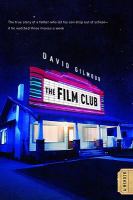
The Film Club / by David Gilmour
Monday, October 18, 2010
Chainsaws, Slackers and Spy Kids: 30 Years of Filmmaking in Austin, Texas / by Alison Macon

.
When Tobe Hooper's low-budget horror classic The Texas Chainsaw Massacre burst through to the mainstream in the 1970's, it was only the beginning as the city's progressive film atmosphere began to attract wannabe filmmakers from all over, soon gaining ground as one of the treasured enclave's of independent film. It didn't hurt that the University of Texas Radio-TV-Film program was already one of the best in the country, only to grow in size and become more diversified in the following years. By the 1990's, Austin achieved legitimate notoriety as an unique landmark independent filmmaking trail. Breakthrough directors Richard Linklater, Robert Rodriguez and Mike Judge proved that local and sub-regionally produced films such as Slacker, Dazed and Confused, El Mariachi and Office Space could make noise at the national level at the same time that homegrown talented actors like Matthew McConaughey and Renee Zellweger made splashes in Hollywood.
.
Lifelong resident and tenured UT film professor Macon chronicles the rise of the Austin's film community through its early days in the 1970's on to its Generation X-charged atmosphere in the late 1980's and early 90's and finally relates how the city has become a major venue for twenty-first century Hollywood blockbusters like Spy Kids. While Austin continues to perpetuate its open-ended, democratic approach to the movie business, Macon hints that their may be a downside to the city's ever-expanding status as a movie and entertainment mecca, namely that rising production costs could mean limited opportunities for local filmmakers as the city opens its arms to industry financiers with bigger pockets. More on the Austin movie scene can be observed at websites like the Austin Film Society's well-informed take on all the cinematic goings-on around the city. (791.4309764 MACOR)
Monday, October 4, 2010
Zeroville / by Steve Erickson

.
Vikar is an obsessive, almost possessed devotee to the movies, having only seen his first real film at the age of 16--his rigidly pious, overbearing father disallowing all forms of popular entertainment. He has since become enraptured by all things silver screen; the actors, directors, cinematography, production design, etc. all drawing him almost trance-like back to the the theater, often multiple times in one day. Now in Hollywood, a place Vikar is sure he will find people to share his love for the cinema, he discovers the world around him to be oddly clueless. The hippy landscape on which he's landed is largely disassociated from moviemaking, instead focused more on drugs, sex, music and progressive activism. In addition, it's a culture now targeted by the authorities owing to the recent Manson family murders. Vikar, ever conspicuous with his peculiar appearance and vagrant status living as a tramp in the Hollywood Hills, has even been interrogated on suspicion of his own involvement with the crime even as he's never heard of Charles Manson or his "family"
.
Zeroville is an exquisite literary experience. Reminiscent of Don Delillo or Thomas Pynchon with its unconventional structure--terse 1 or 2 paragraph chapters and idiosyncratic subject matter--the novel is a refreshing work by a talented writer, equally provocative and entertaining at every turn. The author of award-winning novels like Amnesiac, Arc d'X and The Sea Came in at Midnight, Erickson's work has been described as apocalyptic for its rendering of themes involving dysfunctional societies and isolated characters. Zeroville carries this notion to a new level with a familiar place and time inhabited by quite a unique individual surrounded by a world seemingly on the edge of destruction. (FIC ERICKSON)
Monday, July 19, 2010
The Life and Times of Homer Sincere: Whose Amazing Adventures Are Documented By His True and Trusted Friend Rigby Canfield / by Nathaniel Lande
 .
. Rigby Canfield and Homer Sincere are best friends in 1930's New Orleans when their story begins, both living in the French Quarter despite belonging to polar opposite social classes--Rigby's family is rich, Homer is more or less a destitute orphan. Meeting over a game of marbles one day, the two instantly hit it off, united by their love of the Cinema with the local Rialto Theatre, showcasing their ultimate hero Billy Sunshine, becoming their weekly ritual. Not satisfied just to two watch movies, Rigby and Homer begin filming their own with an long-saved-up-for 8mm camera, recording the goings-on of their colorful neighborhood which usually includes its daily amusements, sideshows, frequent parades and one very savvy, rhyming vegetable cart owner named Waldo--always their leading man.
.
Things fast-forward to years later when both Rigby and Homer, still best friends, are in New York City working as journalists where each cultivate their creative vision through jobs with the Time-Life news group. Together and separately they're afforded the opportunity to witness some of the period's most high-profile events in some of the world's most high profile places. It is in New York also where both fall in love with the same woman, Daisy, a beautiful, intelligent modern working woman who provides the crucible for which the pair's friendship must pass. Their bond survives though, just as it did in the early years, the two remaining united through their one fervent passion: movies. Having never forgotten their ultimate dream, the pair soon resettle in California where they confront the monster that is the world of Hollywood show business.
.
'Homer Sincere' is about many things: friendship, humanity, following your dreams, the mid-twentieth century as perceived through popular events and entertainment, Americana and the cultural influence of Hollywood on a generation, etc. Lande takes tidbits from his own background as a reporter for Time magazine as well as his tenure as a film critic, and weaves together a story as unforgettable as any of the more recent coming-of-age tales, chronicling the eventful, pivotal years of the last century in all its abundance and progress through two very real, very determined and very enduring individuals. (FIC LANDE)
.
'Homer Sincere' is about many things: friendship, humanity, following your dreams, the mid-twentieth century as perceived through popular events and entertainment, Americana and the cultural influence of Hollywood on a generation, etc. Lande takes tidbits from his own background as a reporter for Time magazine as well as his tenure as a film critic, and weaves together a story as unforgettable as any of the more recent coming-of-age tales, chronicling the eventful, pivotal years of the last century in all its abundance and progress through two very real, very determined and very enduring individuals. (FIC LANDE)
Subscribe to:
Posts (Atom)