Showing posts with label high school. Show all posts

Wednesday, June 15, 2011

All The Right Moves (DVD) 1983 / a film by Michael Chapman; starring Tom Cruise, Craig T. Nelson and Lea Thompson


For 18-year-old Stefan "Stef" Djordjevick, the only way to escape his bleak Pennsylvania steel town is with a football scholarship. A star defensive back on his high school team, he knows that each game, each performance is critical to the rest of his life. Stef's not the only one who wants out. Everyone including his girlfriend wants to escape their grim surroundings and the inevitably dismal future which comes with it. Even Stef's head coach, the gutsy but verbally abusive Coach Nickerson dreams of riding his winning team to a championship and hopefully a much better position ("somewhere far away") as an assistant in college. The night of the defining game holds high stakes, higher still when things don't go right and the tension between Stef and Coach Nickerson becomes hostile to a point where both their plans and dreams come crashing to a hault.

Right from the start, this movie makes one thing unavoidably clear: there's a mill, and it's not an all that happy-fun place to work. Like the wide-screen close-up of a frozen Jack Nicholson revealed in Kubrick's The Shining, the steel mill is brought abruptly to viewer attention in the film's opening shot. There is nothing even remotely good about the mill. Absolutely everything, every devastatingly sad element of the town from its name, Ampipe, dubbed after the "American Steel & Pipe" company, right down to the drab homes of the workers emanates from the tomb-like structure atop the hill.  No one is left unscarred by its grim (and grimey) presence, from the miserable workers who trudge up the hill every morning to the even more miserable workers who are laid off daily and the multitudes of dependents and non-workers who, like Stef, plod through lives of quiet desperation. Consequently there are no smiling faces in Ampipe, only the leering, hungover scowls of men and the vacant stares of defeated women. The one outlet (other than alcohol) available to the people of Ampipe is also something toxic, as corrupting and pestilential within itself as the pollution spewing from the smoke stacks. Given to living vicariously through the lives of 17 and 18-year-olds, the entire town exists in a sort of emotional vacuum where a stumble here or a miscall there defines far more than collective misfortune. It proliferates a system which necessitates bitter personal conflicts, distorts the truth, neglects higher priorities and fosters evil intentions. The individual opportunities created stand as the lone redeeming element. That the theme of dead-end industrial commerce within a small, rural community is relentlessy driven home for viewer enlightenment is probably a good thing because nothing else in the movie is very significant. As a film All The Right Moves is, well, kind of dumb. Cliche, cliche, cliche--it goes without saying. It's a little embarassing watching Tom Cruise, who looks so ridiculously out-of-place that comparisons to Rudy will inevitably get thrown around by viewers who've only seen the latter, and even the always effervescent Lea Thompson seems badly miscast as the dowdy, enabling girlfriend whose own passions for music are cruelly overlooked. But the movie's so dated it entertains with its camp value, maintaining a kitsch effect popular with 80's movies these days, much of it do to the lamentably tacky (funny in an ironic way) teen aphorisms and awkward slang strewn throughout the dialogue. Plus, like so many bad books and movies, the cover art is noticeably good. (DVD ALL) 

Tuesday, April 26, 2011

187 (DVD) 1997 / a film by Kevin Reynolds; screenplay by Scott Yagemann; starring Samuel L. Jackson, Clifton Collins Jr., John Heard and Kelly Rowan


"Like you, I used to think the world was this great place where everybody lived by the same standards I did, then some kid with a nail showed me I was living in his world, a world where chaos rules not order, a world where righteousness is not rewarded. That's Cesar's world, and if you're not willing to play by his rules, then you're gonna have to pay the price."

High school science Trevor Garfield is one of a special breed of people with a sincere desire to teach. His is not just a passion to instruct his pupils on the wonders of the scientific world, but a deep need to influence the young lives he comes into contact with, especially the lives of those who are on the cusp of making potentially life-altering choices. It's not an easy job. At the Brooklyn school where he teaches, he struggles to maintain order in his always disruptive classes and walk the line between instructor and disciplinarian. When he's forced to give a failing grade to a student, a known criminal named Dennis Broadway, Garfield unwittingly unleashes a premeditated murder hit, a 187, on his own life. Attacked only hours later by a hooded assailant in the hallway, he's severely injured, almost dying prior to emergency rescue. Trevor is placed on stress leave to recuperate from the accident and, during the interval, relocates from New York to Southern California where he eventually offers his services to the public school system as a substitute teacher. He needs the paycheck and, well, he is a teacher. 

The new school he gets a chance at is little different from his former one. A woefully disorganized institution badly in need of repair, it's a place where the principals are defacto politicians who've never taught and the classrooms are hot, crowded cesspools of juvenile delinquents. The true students, the ones who have a chance are overshadowed by rambunctious riff raff, many of them active gang members, who willfully destroy school property and habitually threaten teachers with violence (like the one Garfield is replacing). It's not long before Garfield himself is threatened by a kid named Benito "Benny" Chacon, a graffito-tagger already under house arrest (an ankle bracelet on his left leg) who seems to enjoy terrifying his teachers and getting away with it--a pending lawsuit involving the school district has prevented his removal from the classroom. Other troublemakers, like Cesar, a less menacing version of the Benny, take center stage when Benny is notably absent from school. Cesar is actually someone Trevor thinks can be helped, seeing the kid as one of those caught-in-the-middle types. But what he finds is just the opposite. Some people, it seems, just don't want help.

187 was released to mediocre reviews, the critics hailing it as an unrealistic portrayal of urban high school life. Somehow this notion carried weight even with the screenplay written by a former teacher, Yagemann, who not only experienced documented cases of being threatened by students but worked under the supervision of a principal who'd never once taught in a classroom. Much of the drama is indeed laid on thick at times and the harsh thematic material involving the often unwinnable world of public education can be difficult to take in. There's also some awkward scenarios within the last third of the film which beg the question of plausibility. But aside from imperfections, there's an authenticity to the movie, its characters especially, which make parts of it undeniably brilliant. Jackson as Trevor and Clifton Collins Jr. in particular as the almost-too-believable Cesar (Collins Jr. then billed as Clifton Gonzalez Gonzalez), both of them converging into the same type of insanity as the film nears its conclusion, create a foreboding picture of not only the microcosm of formative education but of a world which rewards compassion and courage with contempt and corruption. It's a system which leads more than a few, many of them very strong-minded individuals, down the path of fear and frustration to a dead-end scenario of despair and contempt. (DVD ONE)

Monday, February 28, 2011

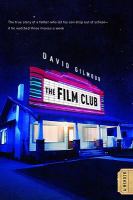
The Film Club / by David Gilmour

What if you could get away with skipping school in order to watch movies all day? One kid did. It's essentially the deal author David Gilmour made with his teenage son Jesse. No longer seeing the purpose of an education, the youth had let it be known at the beginning of the 10th grade that he was planning to quit school after his sixteenth birthday. Gilmour allowed his son to get his wish (and be allowed to live at home) under the following condition: that he, Jesse, promise to watch three movies a week with his father. Beginning "the film club"--the tag denoting the duo's nightly sessions in the basement--with Truffaut's The 400 Blows, Gilmour and son ran the gamet of from classic cinema like Roman Holiday to popular movies (Basic Instinct) and everywhere in between. There were no lectures preceding or following viewing any of the films, no tests on the finer points of cinematic art: just a father and son watching movies together. Gilmour, a former film critic and current TV host in Canada, orchestrates one of the more extreme (or maybe not so extreme as all that though at least original) child-rearing experiments in recent memory. Apparently the little parenting gamble worked, at least to some degree: Jesse began attending college-level courses after getting his GED equivalent. (B GILMOUR)

Monday, February 14, 2011

These Things Hidden / by Heather Gudenkauf


"I have no money, no job, no friends and my family has disowned me, but I'm ready. I have to be."

There aren't many secrets in tiny Linden Falls. So when 
popular teenager Allison Glenn is sent to prison for an unspeakable crime, it's not just her previously flawless reputation that gets tarnished. Her family suffers too, so much so that they want nothing to do with her after her release five years later. Her parents even deny Alison's existence, cutting ties with their daughter in abrupt fashion and doing the whole "never mention her name" bit. No one seems to pity Allison: her former friends whisper maliciously about her, classmates jealous of her beauty and talent glory in her downfall and others join in the constant mocking of her younger sister Brynn in the school hallways. Brynn herself mirrors her parents disdaining attitude but can't help be drawn back to the night of the incident and the real truth about what took place. It may seem like Brynn's burden to bare, and her parents to a lesser extent, but others are involved.

Others like Charm Tullia who seems removed from the Glenn family's circumstances but perhaps not so far as she'd like. Currently caring for her ailing stepfather while going to school to become a nurse, Charm would like to forget the past but also can't hide from the truth and what she knows. Also involved are Claire and her husband Johnathan, the local booksellers who've recently adopted a little boy, Joshua, who was found abandoned near the town's firestation. Knowing little about the Allison incident yet drawn in all the same by the web of secrets steadily permeating through the town, the young couple and their young son soon find that they too are a part of the past, a very big part indeed. Gudenknauf's The Weight of Silences was a dazzling debut. And while These Things Hidden doesn't carry the same allure and novelty, it's no slouch either. A literary thriller of sorts in which the oh-so-horribly scandalous incident driving the narrative isn't revealed until much later, the author paints a vivid portrait of interconnected lives and how even the smallest choices matter. With tidily hinted clues implanted throughout, the story is one which will peak reader interest all the way until the final penultimate revelation sets everything anew and changes everyone's lives forever. (FIC GUDENKAU)

Wednesday, July 14, 2010

Ordinary People / by Judith Guest

Judith Guest grew up as an aspiring writer throughout high school and college, majoring in English and Psychology at the University of Michigan. Her first and still best-regarded book Ordinary People originally began as a short story, eventually growing longer as Guest continued to explore the characters in greater depth. After winning the Kafka Prize for best first novel in 1976, the book was adapted for the big screen by director Robert Redford (his directorial debut) and would go on to win the Oscar for Best Picture. Redford and then teenager Timothy Hutton would also win Oscars for Best Director and Best Actor respectively.
.
."They are people of good taste. They do not discuss a problem in the presence of the problem. And, besides, there is no problem. There is just Phase Two. Recovery. A moving forward." (p. 4)
.
Conrad Jarrett is 17 and a student at Lake Forest (IL) High where in addition to academics, he participates on the swim team and sings in the choir. He's a seemingly well-adjusted youth, having been brought up in a priveleged home with two loving parents, an established group of friends, college on the horizon and even a few flirtatious love interests. But Conrad is anything but alright. The same goes for his parents, Calvin and Beth Jarrett, who not only have no idea how to deal with Conrad, but are visibly becoming unhinged themselves in the wake of two recent family tragedies--the accidental death of the Jarrett's older son "Buck" and Conrad's own attempted suicide just under a year ago.
.
Things are in a bad way for the Jarrett household which is shaky at best, the trio weighed down by emotional tension, more or less isolated from each other since Conrad's return from the hospital some months ago and at a loss to forge any continuity or mutual intimacy. Mom Beth scampers about, busybodying herself with a myriad of social functions, trying to suppress her still cavernous grief over Buck's death, all the while behaving in a passively-aggressive, even dismissive manner towards Conrad, the less-favored son. And while Calvin is openly warm and affectionate toward all, his own naieve efforts to change things usually end in failure. Though his one notion, getting Conrad to see a psychiatrist, does finally garner some feedback and, if not family togetherness, then at least some insight into what's actually going on.
.
Several things set Ordinary People at a level above the montage of suburban soap operas, semifactual docudramas or depressing after school specials. There's the integrity of the story, its matter-of-fact but not stereotyped people and situations, and its development of the characters. Circumstances don't change a whole lot between the time the novel begins sometime in autumn and when it concludes around late winter: Conrad's still depressed, Beth's still decimated with grief and Calvin's still rankled at the inertness of his life. The affluence of the Jarrett's surroundings is clearly apparent but never promoted as a reason for each character's turmoil. Pain, problems and grief originate within each individual and flow outwards; and though all three protagonists are provided with the opportunity to examine themselves, pinpoint the source of distress and push forward towards a resolution, not all are up to the task. (FIC GUEST)

Monday, April 12, 2010

Election (1999) DVD / a film by Alexander Payne; based on the novel by Tom Perrotta; starring Matthew Broderick & Reese Witherspoon

"None of this would have happened if Mr. McAllister hadn't meddled the way he did."
.
All Jim McCallister ever wanted to do was teach. A man of modest means and wants, he sincerely enjoys his days instructing the students in his US Government classes at Carver High, interacting with their young intellects and watching their growing minds confront the world. He likes it when they do well, when they achieve and, in most cases, when they excel. But one thing he does not like, in fact, something he's recently come to loathe vehemently (exceedingly more so since a pivotal indiscretion got his best friend fired) is students driven to succeed at all costs, ones like junior Tracy Flick who unswervingly pursue selfish aims at the expense of others and proceed to make a hollow mockery out of the democratic notion of an election--especially one as trivial as the race for student body president. For Mr. McAllister, the Tracy Flicks of the world do the most damage; they're far more harmful than any combination of troublemakers, burnouts or juvenile miscreants and more determined besides. Tracy might be able to conceal her covetous ill-tempered demeanor behind a facade of way-too-perky cheerfulness, but Jim knows, even if no one else does, that she's a ruthless, wanton firebrand who must be stopped.
.
Everyone at Carver knows who Tracy Flick is, even if they're not really friends with her (or would want to be). Tracy is a compulsive overachiever, the kind of student who promptly shoots up her hand to answer every question, studies fastidiously and stays everyday after school participating in all manner of transcript-worthy activities and every possible extracurricular, particularly ones befitting the 'leadership' mold, hence her devotion to the student council. With her impeccable grades, tenured SGA track and abundant publicity material (posters, banners, pens, buttons, cupcakes, etc.), Tracy's confident of her impending nomination and forthcoming election as student body president, even more so as it looks like she'll be running unopposed. That is, until out of the blue, a second candidate enters the race, popular jock Paul Metzler, and then even more bizarrely, a third, his sister Tammy, who's nomination speech is wildly applauded for its decidedly anarchist platform. Convinced her destiny is being interfered with ("The weak are always trying to sabotage the strong") an insistent Tracy sets her sights firmly on her goal, taking the action she feels is necessary to ensure her success on election day.
.
Election really isn't a high school movie, even with Matthew Broderick's ironic and deviliciously satirical portrayal of well-meaning educator brought to his knees by the headstrong actions of one of his students. It's a movie about people and personalities, how the confluence of individuals confined within institutions inevitably breeds far-reaching repurcussions which are usually harmless, but can, at times, be totally life altering. The film's use of voiceover narration is spot on; input by all four principle characters presiding 'above' the action in a monotone, even-keeled delivery provides a clever nuance to this admirably introspective film. There's a pervading sense of open-mindedness about things. The mood's never overly demonstrative or mean-spirited, just observant and mildly curious, offering a story which plays like a fable or parable as much as an anecdotal piece. Directory Alexander Payne's (Citizen Ruth, About Schmidt) use of satire is refreshingly omnidirectional and without malice, providing a non-partisan, even-handed take on the world and its wrongdoers who might ruin things for others and create a mess but are never all that bad--just, well, real.

Thursday, August 20, 2009

The Overachievers: The Secret Lives of Driven Kids / by Alexandra Robbins

.
The world of college admissions isn't what it used to be. Only a few decades ago, good grades were, in many cases, all you needed to gain admission to the institution of your choice. Nowadays, even straight A's and near-perfect SAT scores can't guarantee entry into even more modestly prestigious schools. Such a high-stakes educational culture has spawned a generation of driven kids perpetually competing for the limited number of slots at the nation's most selective colleges and universities. Setting aside personal interests for more college preparatory routines, many of today's college-bound high school students ardently push themselves through endless hours of study, multiple extracurriculars and other "admissions friendly" activities in an effort to gain entry into the upper-echelon arena of higher education. "Well-roundedness" and "versatility" are major buzz words. So many of today's kids bent on getting into their "first-choice", even as acceptance rates at most elite schools remain intimidatingly small, that every facet of each student is all the more important. Bluntly stated, "You can't just be the smartest. You have to be the most athletic. You have to be able to have the most fun. You have to be the prettiest, the best-dressed, the nicest, the most wanted . . . and, above all, you have to appear to be happy" (p. 42).
.
In her follow-up to Pledged, a poignant in-depth look at college sororities, author and journalist Alexandra Robbins profiles a select group of overachieving high school seniors at Walt Whitman High School (Bethesda, MD), each daily enduring the pressures to not only perform well academically, but to fulfill a complex set of "preferred qualifications" deemed necessary for eligible applicants to top-tier universities. That each student is abundantly qualified goes without saying. Increasingly more important in regards to the model application is the "life experience" aspect. Potential students with impeccable grades and accompanying accolades are frequently disappointed to learn that their shiny resume is totally void without evidence of authentic exposure to the real world at large. "You would have to have lived in Mongolia for two years or have been in a civil war", one of Robbins' profilees was told when considering applying to Stanford. What stands out as a glaring counter-effect to this ultra-competitive system, and what Robbins subtly attempts to reveal, is how the entire function of education is essentially turned on its head--the process of learning and acquiring knowledge has been superseded in place of the ambition to secure approval and acceptance from the institutional realm.

Wednesday, July 15, 2009

Never Change / by Elizabeth Berg

.
Elizabeth Berg is an American novelist gifted with an ability to generate sympathy for largely unappealing characters. Her novel Open House was an Oprah Book of the Month in 2004. In Never Change, lonely middle-aged Myra Lipinsky plods through her spinster existence until her job as a hospice nurse reconnects her with an old friend from her teenage years, a man now terminally ill with a brain tumor.
.
.
"I am the one who sat on a folding chair out in the hall with a cigar box on my lap, selling tickets to the prom..." p.5
.
Self-characterized as something of a dateless wonder throughout her youth and into adulthood (though she "would have gone if asked"), 51-year-old Myra Lipinsky has become accustomed to the reclusive, independent lifestyle. Her nursing career's been rewarding enough to acquire what she feels is relative contentment and she does have her dog, Frank, for companionship. But when, by chance, she becomes caretaker to her long-ago hearthrob Chip Reardon, Myra finds that the unrequited love she once had in high school is still going strong, even if Chip is dying of cancer.
.
Thirty years later, Chip is still the same ("the boy Chip dressed up as the man Chip") and single, never having married though never lacking opportunities. His diminishing condition withstanding, Myrah finds to her delight that remnants of the pair's affable relationship from high school are still intact, progressively becoming more intimate as time passes. The mutual accountability warranted by Chip's illness and Myra's affection and compassion soon gives way to genuine chemistry shared by each, manifesting a "something-more-than-friends" kind of bond as Myra seizes the opportunity she'd secretly longed for so long ago while there's still time.
.
Berg is a very pleasant writer, "reassuringly predictable"* in her premise, story arc and resolution, depicting ordinary, anti-glamorous protagonists amidst equally run-of-the-mill situations. Though unpleasant and perceivably heartbreaking events are guaranteed to occur, rarely does the reader sense that Berg's heroines, in this case Myra, won't be able to overcome it. Emotional growth and enlightened revelations are major spotlight issues (i.e., Chip really can love Myra the way he's loved more attractive women, Myra really is cared for at large, even the most severe grief can be gotten over, etc.).
.
*Publishers Weekly

Wednesday, December 26, 2007

Rats Saw God / by Rob Thomas

Semi-local author Rob Thomas has published several YA novels over the past decade. This, his first, chronicles teenager Steve York at multiple times during high school. Steve's last day of eighth grade is turned on its head when his parents announce their impending divorce ultimately sending his mother and sister to San Diego and him to Houston to live with his repressive (and somewhat despotic) father--"The Astronaut". Facilitating things the best he can amidst unfamiliar surroundings, Steve carves out his new existence; gradually making friends and learning to survive his homelife simultaneously. His saving grace appears in the form of Wanda "Dub" Varner, with whom a steady-crush morphs into love by the end of freshman year. Until its bitter end his junior year, the reader is let in on all the relationship's details through segmented entries describing the 'then' blissful romance and his 'now' emotionally-reduced, drug-addled life after the break-up.

Though Thomas' later books were less well-received, Rats Saw God will find an audience with its drenched-in-sarcasm attitude and gritty realism. The 'then and now' style really fleshes out Steve's personality and relationships; displaying how both compliment each other and play off his actions. Generation X & Y'ers of the 80's/90's period will identify with the book's cultural aspects.

Monday, November 19, 2007

Vision Quest / by Terry Davis

Louden Swain lives ‘over-the-edge’ caring little for rationale or sensibility. A high school wrestler anticipating his career-defining match, he perpetually denies himself, eating just enough to sustain his body while pushing it to (and beyond) its natural limits. Mentally his concentration never wanes from the impending match and opponent Gary Shute. It’s his own battle but he’s never alone with a supportive father and live-in girlfriend not to mention his coach and dedicated teammates.

Before Cris Crutcher made it cool to be a triathlete, Terry Davis wrote Vision Quest. Published in 1979, this was a new kind of YA novel. This is not a sports book as there are no archetypal action sequences or inevitable 'championship' climaxes. Rather it's an intrapersonal soul journey, a story of being not doing. Louden’s focus is the pain, the emotional reflection as he trains the theme rather than the culminating event itself. Like any 'YA' book, it's concentrated on adolescence but doesn't exclude other audiences and would be a great read for anyone.